
The Best Place to Fail is the Lab
The Best Place to Fail is in the Lab
Why better teams build better buildings
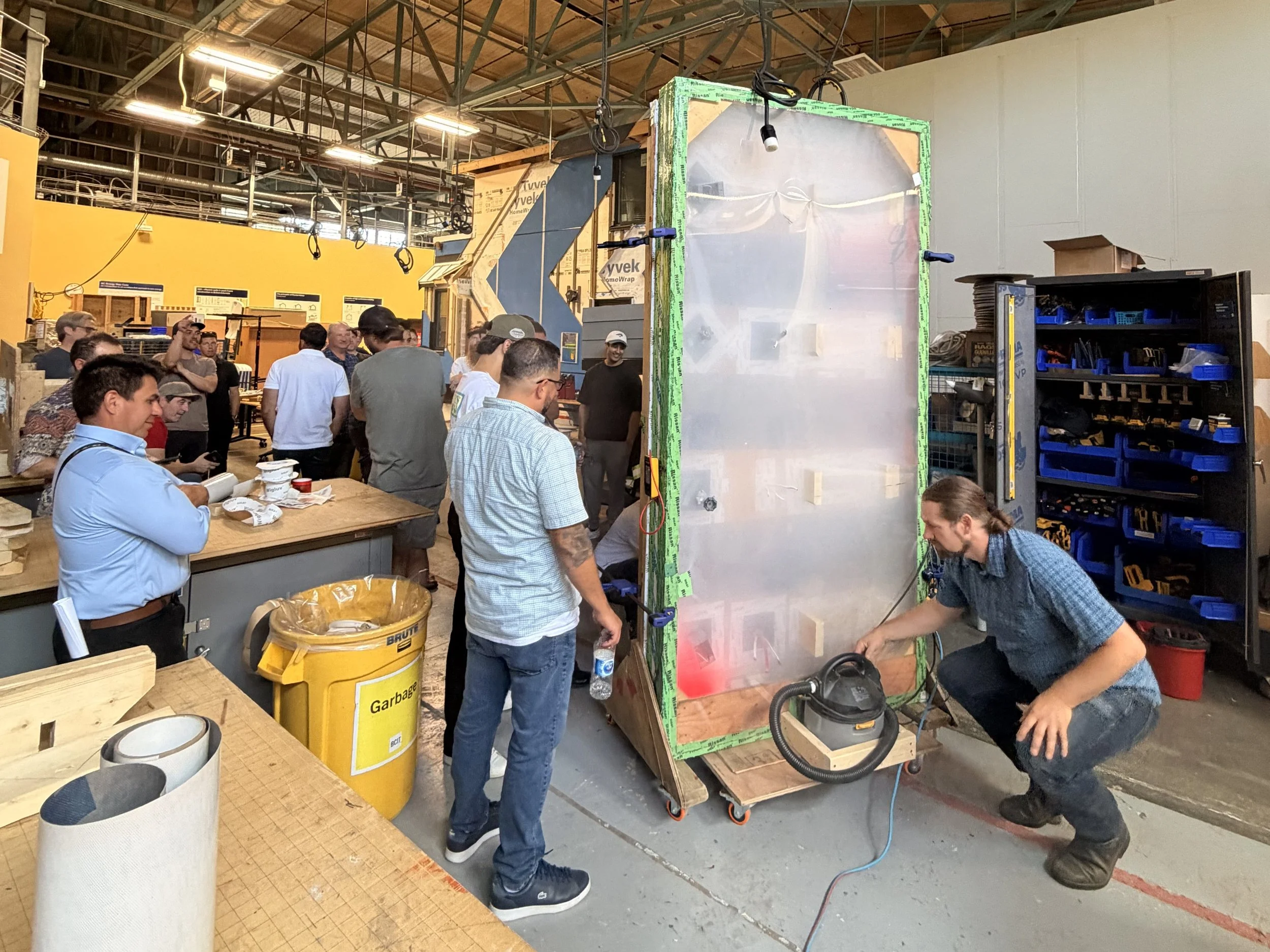
Last week, I had the opportunity to work with Ventana Construction, their trades, and members of the design team during a private high-performance building workshop at BCIT.
It was one of those days that reminded me why this kind of training matters.
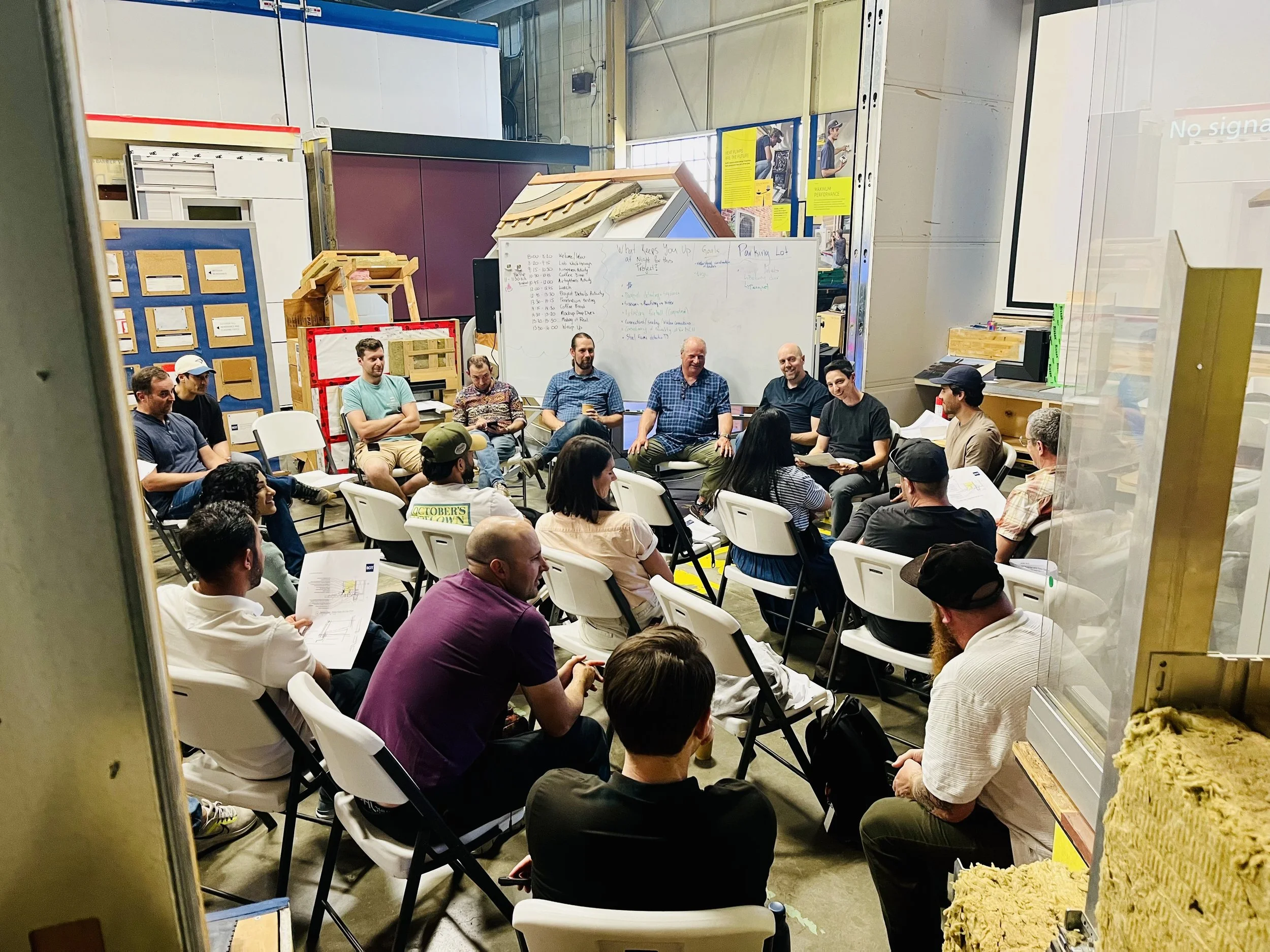
Detail Review Discussion with Ventana and the design team at the BCIT High Performance Building Lab. Photo Credit: Alexandre Hebert.
Why better teams build better buildings
Last week, I had the opportunity to work with Ventana Construction, their trades, and members of the design team during a private high-performance building workshop at BCIT.
It was one of those days that reminded me why this kind of training matters.
There were technical conversations about airtightness, sequencing, details, penetrations, and mockups. But there were also bigger “aha” moments. People began to see more clearly how their work connected to everyone else’s. Trades had the opportunity to ask questions directly of the design team. Paheard where certain details may be difficult to build. The general contractor created space for the team to slow down, work through challenges together, and clarify what quality needs to look like before the pressure of construction makes those conversations harder.
That training made me reflect on what I’ve seen over the past eight years teaching part-time at BCIT’s Zero Energy Buildings Learning Centre.
One of the things I appreciate most about the ZEBLC is that BCIT intentionally brings practicing professionals into the classroom. We spend our days working on projects, then bring those experiences—both the successes and the mistakes—back to students and industry. Through that work, I’ve had the privilege of teaching courses, facilitating workshops, and working with project teams across Canada.
Every project is different. Every team is different. But I keep coming back to the same observation:
The projects that achieve exceptional performance are usually the ones that invest in building a shared understanding before construction begins.
That’s especially true when it comes to airtightness.
When people ask how projects consistently achieve Passive House level airtightness targets of 0.6 ACH@50Pa—or in some remarkable cases, 0.4 or even 0.2 ACH@50Pa—they’re often looking for the secret. Is it a particular membrane? A better tape? A proprietary product?
The answer isn’t a secret material and the answer is much more human focused.
It comes down to planning, sequencing, communication, and a team that understands how all of the pieces fit together.
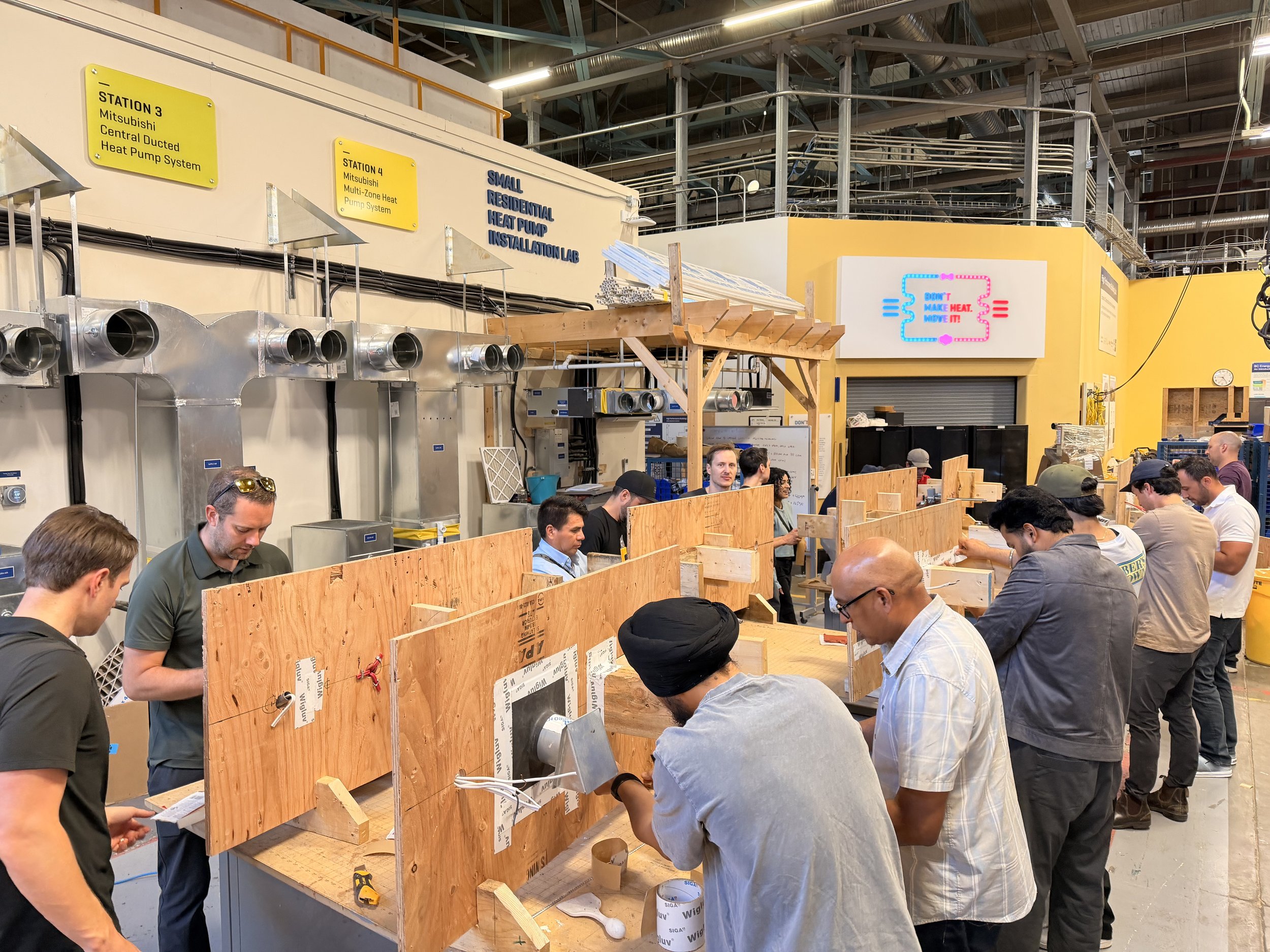
Ventana Team Sealing up Penetrations. Photo Credit: Cody Brentzen
Creating New Habits
One of the things we’ve learned through the work at BCIT and on projects is that high-performance construction isn’t fundamentally more difficult than conventional construction.
It’s different.
Most assemblies are straightforward once you’ve built them a few times. The challenge isn’t understanding a detail on paper—it’s changing habits that may have been reinforced over decades.
We’re asking people to pause before making a penetration. To think one trade ahead. To ask whether someone else still needs access to that location. To recognize that a small hole today may become a difficult leak to find months later.
Those aren’t difficult skills, but they do require focus, presence, and practice.
Like any habit, they take repetition before they become automatic.
Learning Where Mistakes Are Cheap
That’s one of the reasons I enjoy hands-on training so much.
The laboratory gives people permission to make mistakes.
In fact, I hope they do.
One of my clearest memories is from the first airtight window installation training I attended years ago. Our instructor carefully explained the installation sequence and highlighted all the things that commonly went wrong. Our team listened attentively, then walked over to the mock-up and proceeded to do almost everything we had just been told not to do.
We ended up taking the installation apart and doing it again.
At the time it felt embarrassing. Looking back, it was probably the most valuable part of the day.
Making those mistakes created a kind of muscle memory that has stayed with me ever since. Today, when I’m reviewing details on site or talking through an installation with a contractor, those lessons are still there.
I’m much happier that those mistakes happened in a training lab than on a live construction site, where the consequences would have involved schedule delays, change orders, and frustrated project teams.
The best place to fail is where failure is inexpensive.
Where the only thing bruised is your pride.
Building Relationships Alongside Skills
The technical learning is only part of what happens during these sessions.
During the Ventana workshop, one of the most valuable exercises was a collaborative detail review. Small groups worked through specific project details, including parapet conditions, accessible door sill and jamb conditions, and fixed solar shade connections. They reviewed sequencing, responsibilities, and potential challenges, then shared their observations back with the larger group.
Some questions were resolved in the room. Some were identified as important items to test through a larger mockup. Others clearly needed further review. But the value wasn’t only in the answers. It was in the conversation.
Architects began hearing directly from trades about what is easy to build and what isn’t. Some aspects of construction that the design team had struggled to find a clear answer to for years, was answered in 30 seconds. Consultants gained a better understanding of site constraints. Trades saw how their work affected the continuity of the air barrier. The GC demonstrated that quality isn’t just something written into the specifications—it’s something they expect, support, and are willing to invest in.
People also got to know each other.
That might sound like a small thing, but it changes the dynamic of a project. When you’ve spent a day solving problems together, it’s much easier to pick up the phone a few months later and ask a question before making an assumption.
That willingness to reach out often prevents problems long before they become expensive.
We’ve Seen the Results
Over the years, we’ve had the opportunity to work with some exceptional builders who have embraced this collaborative approach.
Before building Angle of Repose, Tom Stead of TS Construction completed BCIT’s High Performance Building Microcredential. On their first Passive House project, they achieved an extraordinary airtightness result of 0.21 ACH@50Pa.
More recently, VanMar Constructors participated in project-specific training before beginning construction of the Hawthorn Passive House. Their final airtightness test came in at 0.4 ACH@50Pa.
I’ll write more about that project in a future article.
Neither of these results happened because of a single product or one particularly clever detail. They were the outcome of teams that invested time up front, worked through sequencing together, and approached construction with a shared commitment to quality.
Perhaps the most encouraging part is watching what happens after people complete this kind of training.
The common response isn’t, “Wow, that’s complicated.”
It’s usually something much simpler:
“That’s actually not so hard.”
And they’re right.
High-performance construction isn’t rocket science. It’s about creating new habits, paying attention to the details that matter, and developing the confidence that comes from practicing them before you’re under the pressure of a construction schedule.
Commitment Shows Up Early
That’s what stood out to me about the Ventana workshop.
The team showed up ready to participate. People were open, engaged, and willing to ask good questions. The trades, design team, consultants, and GC were all in the same room working toward the same goal: delivering a high-performance, airtight building for the client.
That kind of commitment matters.
It sends a clear message that quality is not being left to chance. It shows the trades that the GC is serious about excellence. It gives the design team a better understanding of how their details will be built. And it gives the whole project team a chance to develop shared expectations before the work is underway.
I left the day encouraged by the conversations, impressed by the team Ventana has assembled, and excited to see the project progress.
Continuing the Conversation
Teaching at BCIT has been one of the most rewarding parts of my career. It keeps me connected to students, to industry, and to colleagues who are constantly asking how we can build better buildings. At the same time, the work we do through JMV Consulting allows me to bring lessons from active projects back into the classroom, creating a conversation between education and practice that benefits both.
If you’re interested in developing your own understanding of high-performance construction, I’d encourage you to explore the opportunities available through BCIT’s Zero Energy Buildings Learning Centre.
The Fundamentals of Zero Energy Emissions and Passive House Buildings (XZEB 1001) course is a practical introduction to the principles behind high-performance construction and Passive House design:
https://www.bcit.ca/courses/fundamentals-of-zero-energy-emissions-and-passive-house-buildings-xzeb-1001/
The BCIT Zero Energy Buildings Learning Centre also continues to support industry through applied research, hands-on training, demonstration projects, and a growing library of free technical resources:
https://www.bcit.ca/zero-energy-building/
Whether you’re a designer, contractor, tradesperson, or owner, my experience has convinced me that investing in people is still one of the best investments a project can make.
Better buildings begin with better teams, and better teams are built long before the first shovel goes into the ground.
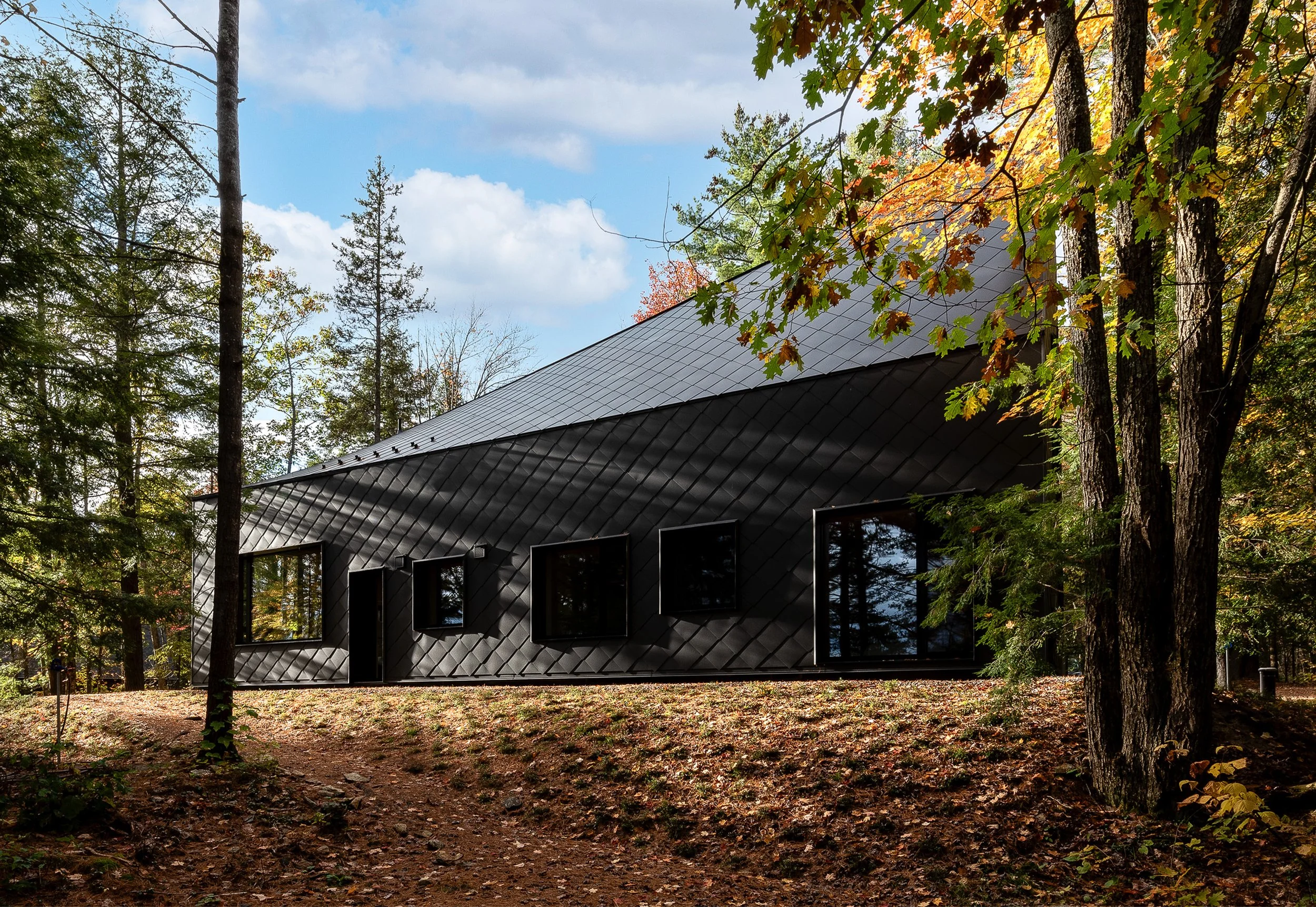
Angle of Repose wins 2026 OAA Design Excellence Award
We're excited to see Angle of Repose recognized with a 2026 OAA Design Excellence Award. JMV served as the Passive House Designer on the project, working closely with Reasonable Projects and the broader team to create a building that demonstrates how exceptional architecture and exceptional building performance can reinforce one another. Through a simple, carefully considered design approach, the project far surpassed Passive House performance targets while creating a comfortable, resilient retreat that sits lightly on the landscape.
Images credit of Jeremie Warshafsky.
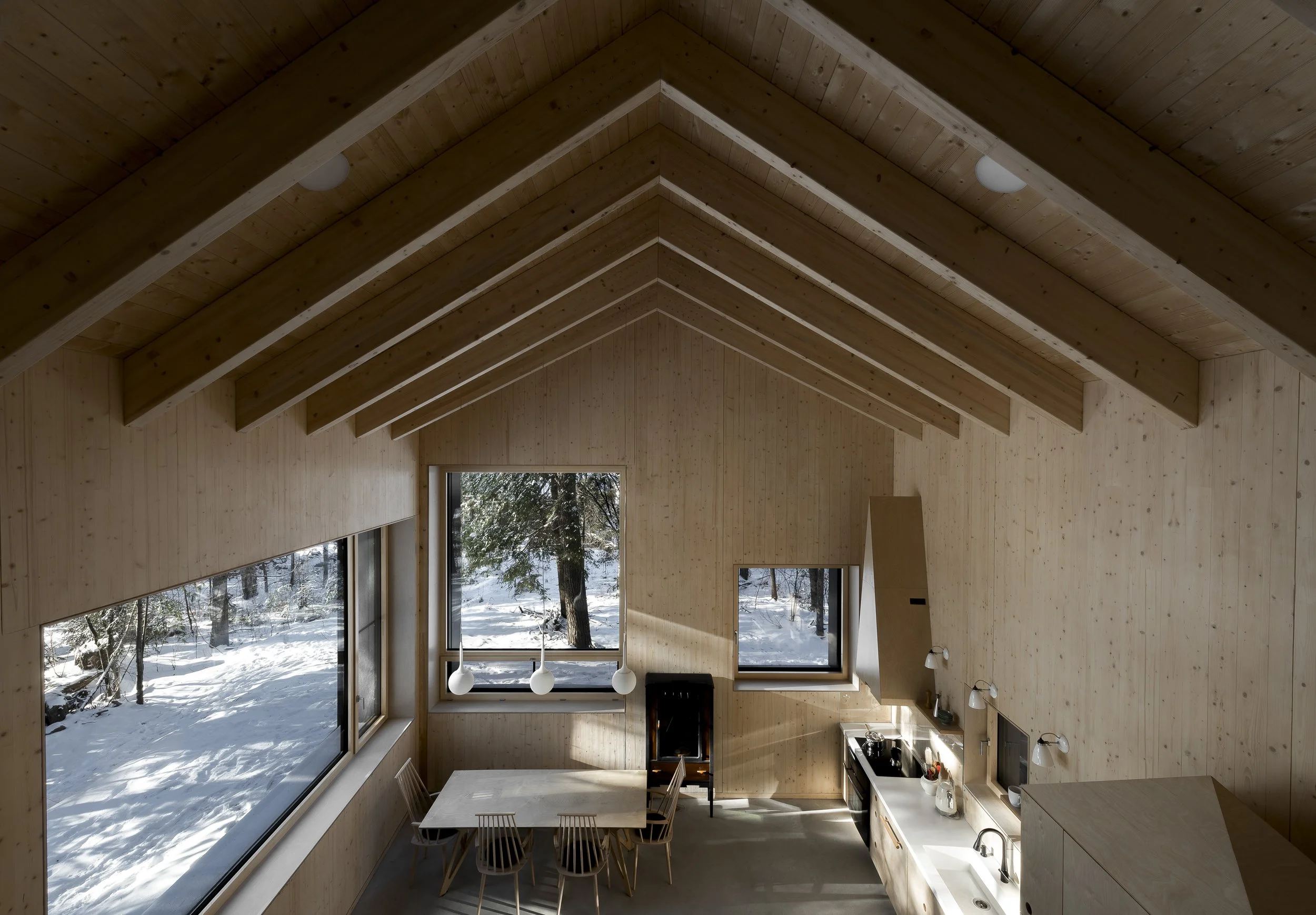
Angle of Repose Great Room. © Jeremie Warshafsky
We're excited to see Angle of Repose recognized with a 2026 OAA Design Excellence Award. JMV served as the Passive House Designer on the project, working closely with Reasonable Projects and the broader team to create a building that demonstrates how exceptional architecture and exceptional building performance can reinforce one another. Through a simple, carefully considered design approach, the project far surpassed Passive House performance targets while creating a comfortable, resilient retreat that sits lightly on the landscape.
Simplicity Creates Performance
One of the most rewarding parts of my job is working on projects that challenge the assumption that sustainability and architecture are somehow at odds.
Angle of Repose, designed by Reasonable Projects and recently recognized with a 2026 OAA Design Excellence Award, is one of those projects.
From the beginning, the project team shared a common goal: create a building that belonged to its site, framed spectacular views of the lake, and provided an extraordinary experience for the occupants. At the same time, we wanted the building to perform at the highest possible level.
The result is a reminder that high-performance buildings don't need to be complicated.
In fact, some of the best-performing buildings are often the simplest.
As the Passive House Designer on this project, JMV worked closely with the architects, builder, and other consultants throughout the project to refine and realize a design that used passive strategies wherever possible. Early solar studies helped optimize the building's angle and orientation to maximize winter solar gain while preserving views and strengthening the connection to the landscape.
The enclosure followed the same philosophy. Rather than introducing complexity, the team focused on simplicity: minimizing thermal bridges, reducing penetrations, and carefully coordinating airtightness details. Every decision made the building easier to build, more durable, and more efficient.
That approach delivered exceptional results.
The project achieved an airtightness of 0.21 ACH@50Pa, nearly three times better than the Passive House requirement. It also achieved a TEDI of 8.9 kWh/m²yr and a TEUI of 26.3 kWh/m²yr, dramatically outperforming Passive House performance targets.
What makes these results particularly interesting is that they didn't come at the expense of architecture.
Large south- and west-facing windows capture expansive views and flood the interior with natural light. Carefully integrated exterior shading allows those generous windows to remain comfortable throughout the summer. Because the enclosure performs so well, the architecture is able to be more open and connected to the outdoors while still maintaining excellent comfort and energy performance.
The project also demonstrates how low-carbon construction can be practical and cost-effective. Approximately 24 inches of dense-packed cellulose insulation were used throughout the enclosure, reducing embodied carbon while providing a more economical solution than many conventional rigid insulation assemblies. The resulting embodied carbon intensity is just 41 kgCO₂e/m², while operational emissions are only 1.05 kgCO₂e/m²yr—less than 4% of those associated with a typical Ontario home.
Another highlight of the project was working with the builder on their first Passive House. Through training provided through BCIT and close collaboration during construction, the team was able to successfully execute the details required to achieve these exceptional performance outcomes.
The completed home is fully electric and requires remarkably little energy to operate. Space heating is provided primarily through a small heater integrated into the fresh-air ventilation system. An air source heat pump is installed with one head to provide additional heating and cooling should the need arise. More importantly, it delivers what every great building should: comfort. Stable temperatures, excellent indoor air quality, quiet interiors, and a strong connection to the surrounding landscape create a home that provides comfort year round.
We're grateful to have been part of a team that proved a simple idea: when a design team works together from the outset, sustainability becomes an enabler of great design rather than a constraint.
Congratulations to Reasonable Projects and the entire project team on this well-deserved recognition.
OAA Article : https://oaa.on.ca/whats-on/bloaag/bloaag-detail/Angle-of-Repose
PROJECT TEAM
ARCHITECTS
Geoffrey Turnbull
Reasonable Projects
Richard Unterthiner
Sole Practitioner
LANDSCAPE ARCHITECT
Julie Bargmann
D.I.R.T. studio
CERTIFIED PASSIVE HOUSE DESIGNER
Joshua Vanwyck
JMV Consulting
STRUCTURAL ENGINEER
Bernhard Gafner
Aspect Structural Engineers
TIMBER DESIGN
Jens Hackethal + Braeden Brennan
Styxworks
PASSIVE HOUSE CERTIFIER
Marine Sanchez + Kathleen Narbonne
RDH Building Science
GENERAL CONTRACTOR
Thomas Stead
TJS Construction
PROJECT PHOTOGRAPHY
Jeremie Warshafsky
Jeremie Warshafsky Photography

Angle of Repose Certified!
Angle of Repose Receives Passive House Certification

Angle of Repose Inside View. Credit: Geoffrey Turnbull
The recently finished Angle of Repose project, a cozy cottage in the northern outskirts of Toronto, has been completed successfully and earned the Passive House certification. This eco-friendly building has robust walls with cellulose insulation. The cottage's design prioritizes Form and Function, integrating components that enhance its energy efficiency. By installing external venetian blinds, the project not only added elegance but also a way to control the indoor temperature. The Angle of Repose project demonstrates the boundless creativity possible through passive house construction in modern architecture.

Ken Soble Tower Certified Largest Residential EnerPHit Project in the World
Ken Soble Tower receives EnerPHit Certification achieving largest residential project in the world to achieve this certification. The project has received many other awards and continues to be recognized internationally.
The Ken Soble Tower has been recognized internationally for achieving incredible energy performance and thermal comfort as the largest residential Passive House EnerPHit project in the world.
JMV Consulting was the Passive House Designer on the project and we’re exceptionally proud of the result and the work of all involved.
The project is now fully occupied and an ongoing study from the University of Toronto is looking at the actual energy consumption, performance and satisfaction of the residents. Stay tuned!
Want to learn more? Below are a list of just a few articles and awards the project has won.
Awards:
•Hamilton Urban Design Awards: Civic Achievement, 2021
•Toronto Construction Association (TCA): Best of Best Awards: Project Achievement, 2022
•EIFS Council of Canada (ECC): Architectural Design Awards Grand Prize, 2022
•Canada Green Building Council (CaGBC) Awards: Green Building Excellence: Deep Carbon Retrofit, 2022
•Engineering News Record (ENR): Global Best Projects: Best Green Project, 2022
•Urban Land Institute (ULI): Terwilliger Center Award for Innovation in Attainable Housing, 2022
•Federation of Canadian Municipalities (FCM) Sustainable Community Awards: Affordable Housing Retrofit, 2022
•Ontario Heritage Trust: Lieutenant Governor's Award, 2022
Articles:
https://www.dezeen.com/2022/03/23/ken-soble-tower-ontario-tallest-retrofitted-passivhaus/
https://www.eraarch.ca/2022/canadas-ken-soble-tower-certified-as-worlds-largest-residential-passive-house-enerphit-retrofit/
https://www.canadianarchitect.com/raising-the-bar-ken-soble-tower-hamilton-ontario/
https://www.cbc.ca/news/canada/hamilton/500-macnab-1.6188431
Case Studies:
https://www.cmhc-schl.gc.ca/professionals/housing-markets-data-and-research/housing-research/research-reports/nhs-outcomes/ken-soble-tower-renewal

Angle of Repose Featured in AZURE
Angle of Repose Cottage Featured in AZURE. Passive House is beautiful, comfortable and functional!
The ultra-efficient and beautiful Angle of Repose has been featured in AZURE Magazine. JMV Consulting acted as the Passive House Consultant on the project. The project has an extremely low embodied carbon using CLT wood structure and 24” of cellulose for the insulation of the walls and roof. The home is heated only by a small heat pump and the hygienic ventilation air.
Check out the project here: Angle of Repose : Azure Magazine
Image credit: Geoff Turnbull

BCIT Zero Energy Buildings Lab Recognized as Inspired Educator
Honoured to be part of the team recognized by the CAGBC as an Inspired Educator. Congratulations to the whole team at the BCIT Zero Energy Building Lab who make high performance building construction straightforward, accessible and fun.

BCIT Zero Energy Buildings Lab Recognized as Inspired Educator 2021
We’re honoured to be part of the team recognized by the CAGBC as an Inspired Educator. Congratulations to the whole team at the BCIT Zero Energy Buildings Lab who make high performance building construction straightforward, accessible and fun.
Check out some of the great videos here: https://commons.bcit.ca/zeroenergybuildings/videos/
Or sign up for one of our virtual courses that takes you into the lab and gets hands on!

Ken Soble Tower completes successful Air Tightness Test
Ken Soble Tower completes successful blower door test
The Ken Soble Tower EnerPHit is reaching completion. The final step before certification has been achieved.
A couple of weekends ago the team completed their blower door test. This is done by using blower door fans and pressurizing the building and measuring how much air is needed to maintain that pressure (hence how much air is leaking through the building). The team worked closely together to ensure a simple design that was easy to construct and the builders and installers have worked meticulously to ensure a quality construction. This paid off. The minimum requirement for EnerPHits is 1 ACH [Air Changes per Hour] at 50Pa [a similar pressure to a very strong wind], to achieve certification on this project the team needed to achieve 0.6 ACH at 50Pa. The final test achieved 0.235 ACH at 50Pa. Well exceeding our expectations and adding some buffer to the Passive House Model and overall energy consumed for the project.
To see the latest pictures of the project check out the video above done by ERA Architects and this article here: https://www.eraarch.ca/project/ken-soble-tower-transformation/
JMV Consulting is proud to be the Passive House Designer on the project and to have worked with the incredible team at ERA Architects, Reinbold Engineer (mechanical) , Entuitive (building envelope), Nemetz (electrical) and Transsolar (thermal comfort / Passive House).

First Ever High-Rise EnerPHit Retrofit in Canada Will Create More Affordable Housing for Seniors in Hamilton
Working with ERA Architects and the whole design team, JMV Consulting is the Passive House consultant for the Ken Soble Tower Retrofit project. As seen below, CMHC has announced major funding to help turn this project into reality.
Through the NHS Affordable Housing Innovation Fund the federeal government is investing close to $3.7M and has a financial commitment of $6.3M through National Housing Co-Investment Fund for the Ken Soble Tower transformation. Other partners involved in the project include the City of Hamilton and the Federation of Canadian Municipalites. This project by CityHousing Hamilton, the retrofit of the 17-storey, vacant and unhabitable apartment building, with Passive House standard, will provide 146 new affordable appartments for seniors.
The Ken Soble Tower transformation will showcase how multi-residential postwar structures may be rehabilitated to the Passive House standard. It will result in significant reductions in energy consumption, greenhouse gas emissions and energy intensity of the building. The Passive House standard reduces operating costs for buildings, which contributes to increased affordability for tenants.
Delivering Lab in a Box Building Science Workshops

On March 8, Joshua Vanwyck was in Nelson delivering BCIT’s new CESA 1050: ZEB Introduction to Building Science, Airtightness, and Assembly Details course. The day focused on the basics of air barriers, envelope assemblies and hands on practice building up a air tight assembly. Twenty five builders, architects and building officials participated also sharing their experiences.
Thank you to the Community Energy Association for hosting the event and BCIT’s Learning Centre for Zero Energy Buildings for developing the course material and Lab in a Box.
The Nelson Star also covered the event in advance: https://www.nelsonstar.com/news/nelson-workshop-will-update-builders-on-energy-efficiency-techniques/
Photo by Patricia Dehnel from CEA.

Ken Soble Tower Retrofit sets sights on EnerPHit Standard
JMV Consulting is working with ERA Architects to take an aging 17 storey CityHousing Hamilton apartment tower and transform it into a Passive House Retrofit. Built in 1967, the tower has 146 units which will be converted into affordable senior housing. The target of the project is to reduce carbon emissions by 90% and reach the EnerPHit standard of 25 kWh/m²/yr heating, 25 kWh/m²/yr cooling and 120 kWh/m²/yr in total primary energy use.
JMV consulting is the Passive House Designer on this project. For more information about the project, or Passive House Certification for large projects: contact us.