
Angle of Repose wins 2026 OAA Design Excellence Award
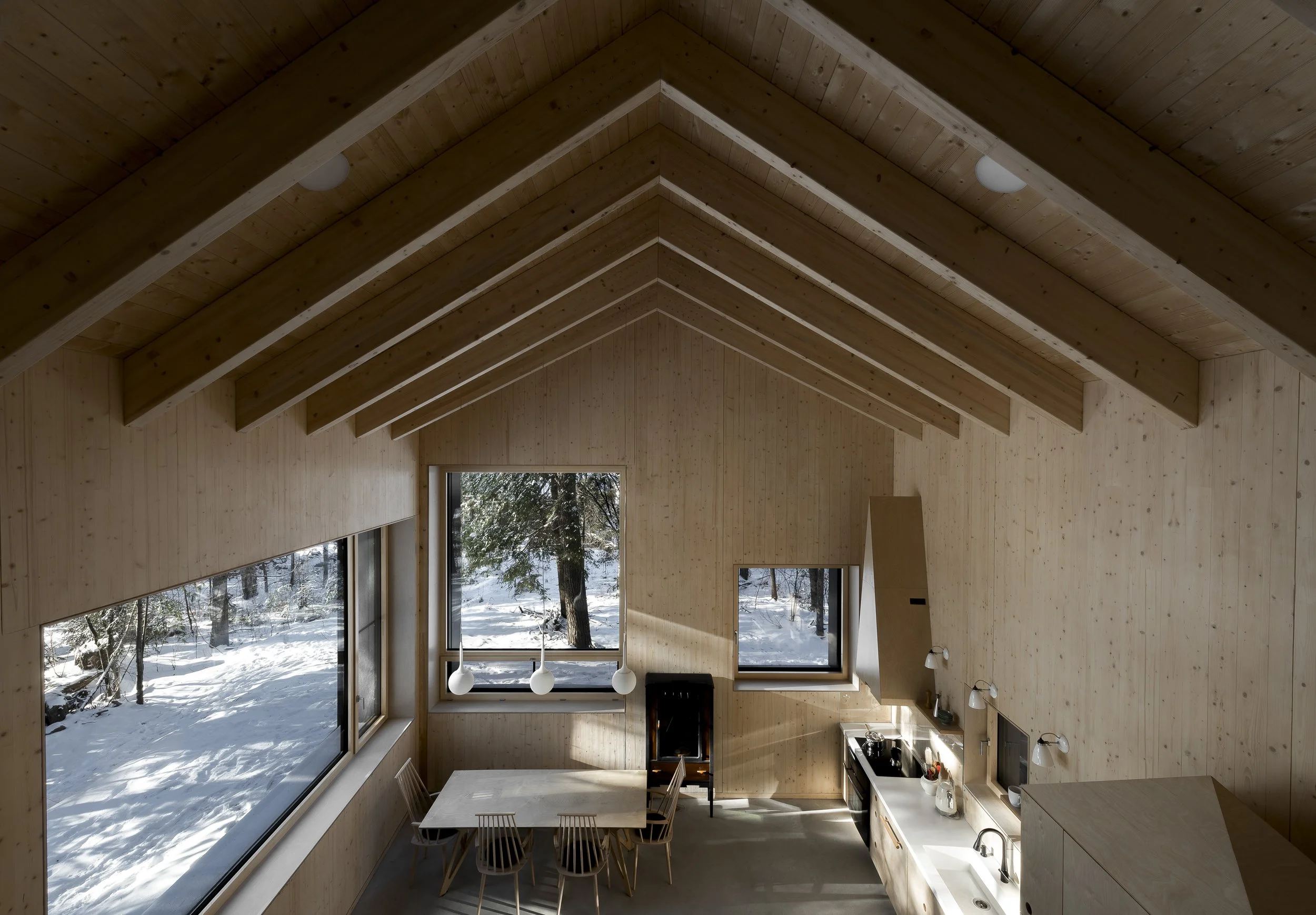
Angle of Repose Great Room. © Jeremie Warshafsky
We're excited to see Angle of Repose recognized with a 2026 OAA Design Excellence Award. JMV served as the Passive House Designer on the project, working closely with Reasonable Projects and the broader team to create a building that demonstrates how exceptional architecture and exceptional building performance can reinforce one another. Through a simple, carefully considered design approach, the project far surpassed Passive House performance targets while creating a comfortable, resilient retreat that sits lightly on the landscape.
Simplicity Creates Performance
One of the most rewarding parts of my job is working on projects that challenge the assumption that sustainability and architecture are somehow at odds.
Angle of Repose, designed by Reasonable Projects and recently recognized with a 2026 OAA Design Excellence Award, is one of those projects.
From the beginning, the project team shared a common goal: create a building that belonged to its site, framed spectacular views of the lake, and provided an extraordinary experience for the occupants. At the same time, we wanted the building to perform at the highest possible level.
The result is a reminder that high-performance buildings don't need to be complicated.
In fact, some of the best-performing buildings are often the simplest.
As the Passive House Designer on this project, JMV worked closely with the architects, builder, and other consultants throughout the project to refine and realize a design that used passive strategies wherever possible. Early solar studies helped optimize the building's angle and orientation to maximize winter solar gain while preserving views and strengthening the connection to the landscape.
The enclosure followed the same philosophy. Rather than introducing complexity, the team focused on simplicity: minimizing thermal bridges, reducing penetrations, and carefully coordinating airtightness details. Every decision made the building easier to build, more durable, and more efficient.
That approach delivered exceptional results.
The project achieved an airtightness of 0.21 ACH@50Pa, nearly three times better than the Passive House requirement. It also achieved a TEDI of 8.9 kWh/m²yr and a TEUI of 26.3 kWh/m²yr, dramatically outperforming Passive House performance targets.
What makes these results particularly interesting is that they didn't come at the expense of architecture.
Large south- and west-facing windows capture expansive views and flood the interior with natural light. Carefully integrated exterior shading allows those generous windows to remain comfortable throughout the summer. Because the enclosure performs so well, the architecture is able to be more open and connected to the outdoors while still maintaining excellent comfort and energy performance.
The project also demonstrates how low-carbon construction can be practical and cost-effective. Approximately 24 inches of dense-packed cellulose insulation were used throughout the enclosure, reducing embodied carbon while providing a more economical solution than many conventional rigid insulation assemblies. The resulting embodied carbon intensity is just 41 kgCO₂e/m², while operational emissions are only 1.05 kgCO₂e/m²yr—less than 4% of those associated with a typical Ontario home.
Another highlight of the project was working with the builder on their first Passive House. Through training provided through BCIT and close collaboration during construction, the team was able to successfully execute the details required to achieve these exceptional performance outcomes.
The completed home is fully electric and requires remarkably little energy to operate. Space heating is provided primarily through a small heater integrated into the fresh-air ventilation system. An air source heat pump is installed with one head to provide additional heating and cooling should the need arise. More importantly, it delivers what every great building should: comfort. Stable temperatures, excellent indoor air quality, quiet interiors, and a strong connection to the surrounding landscape create a home that provides comfort year round.
We're grateful to have been part of a team that proved a simple idea: when a design team works together from the outset, sustainability becomes an enabler of great design rather than a constraint.
Congratulations to Reasonable Projects and the entire project team on this well-deserved recognition.
OAA Article : https://oaa.on.ca/whats-on/bloaag/bloaag-detail/Angle-of-Repose
PROJECT TEAM
ARCHITECTS
Geoffrey Turnbull
Reasonable Projects
Richard Unterthiner
Sole Practitioner
LANDSCAPE ARCHITECT
Julie Bargmann
D.I.R.T. studio
CERTIFIED PASSIVE HOUSE DESIGNER
Joshua Vanwyck
JMV Consulting
STRUCTURAL ENGINEER
Bernhard Gafner
Aspect Structural Engineers
TIMBER DESIGN
Jens Hackethal + Braeden Brennan
Styxworks
PASSIVE HOUSE CERTIFIER
Marine Sanchez + Kathleen Narbonne
RDH Building Science
GENERAL CONTRACTOR
Thomas Stead
TJS Construction
PROJECT PHOTOGRAPHY
Jeremie Warshafsky
Jeremie Warshafsky Photography