
The Best Place to Fail is the Lab
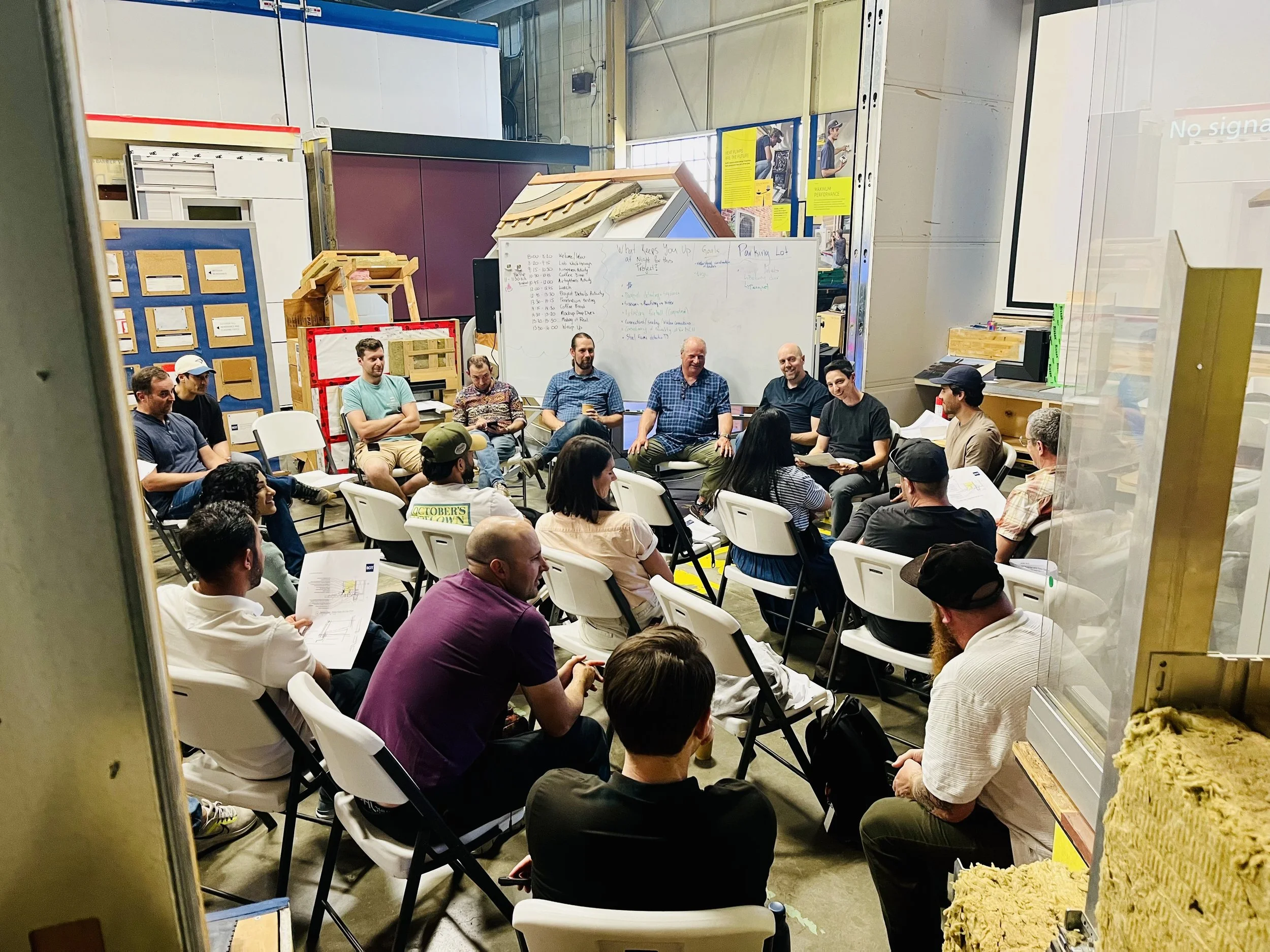
Detail Review Discussion with Ventana and the design team at the BCIT High Performance Building Lab. Photo Credit: Alexandre Hebert.
Why better teams build better buildings
Last week, I had the opportunity to work with Ventana Construction, their trades, and members of the design team during a private high-performance building workshop at BCIT.
It was one of those days that reminded me why this kind of training matters.
There were technical conversations about airtightness, sequencing, details, penetrations, and mockups. But there were also bigger “aha” moments. People began to see more clearly how their work connected to everyone else’s. Trades had the opportunity to ask questions directly of the design team. Paheard where certain details may be difficult to build. The general contractor created space for the team to slow down, work through challenges together, and clarify what quality needs to look like before the pressure of construction makes those conversations harder.
That training made me reflect on what I’ve seen over the past eight years teaching part-time at BCIT’s Zero Energy Buildings Learning Centre.
One of the things I appreciate most about the ZEBLC is that BCIT intentionally brings practicing professionals into the classroom. We spend our days working on projects, then bring those experiences—both the successes and the mistakes—back to students and industry. Through that work, I’ve had the privilege of teaching courses, facilitating workshops, and working with project teams across Canada.
Every project is different. Every team is different. But I keep coming back to the same observation:
The projects that achieve exceptional performance are usually the ones that invest in building a shared understanding before construction begins.
That’s especially true when it comes to airtightness.
When people ask how projects consistently achieve Passive House level airtightness targets of 0.6 ACH@50Pa—or in some remarkable cases, 0.4 or even 0.2 ACH@50Pa—they’re often looking for the secret. Is it a particular membrane? A better tape? A proprietary product?
The answer isn’t a secret material and the answer is much more human focused.
It comes down to planning, sequencing, communication, and a team that understands how all of the pieces fit together.
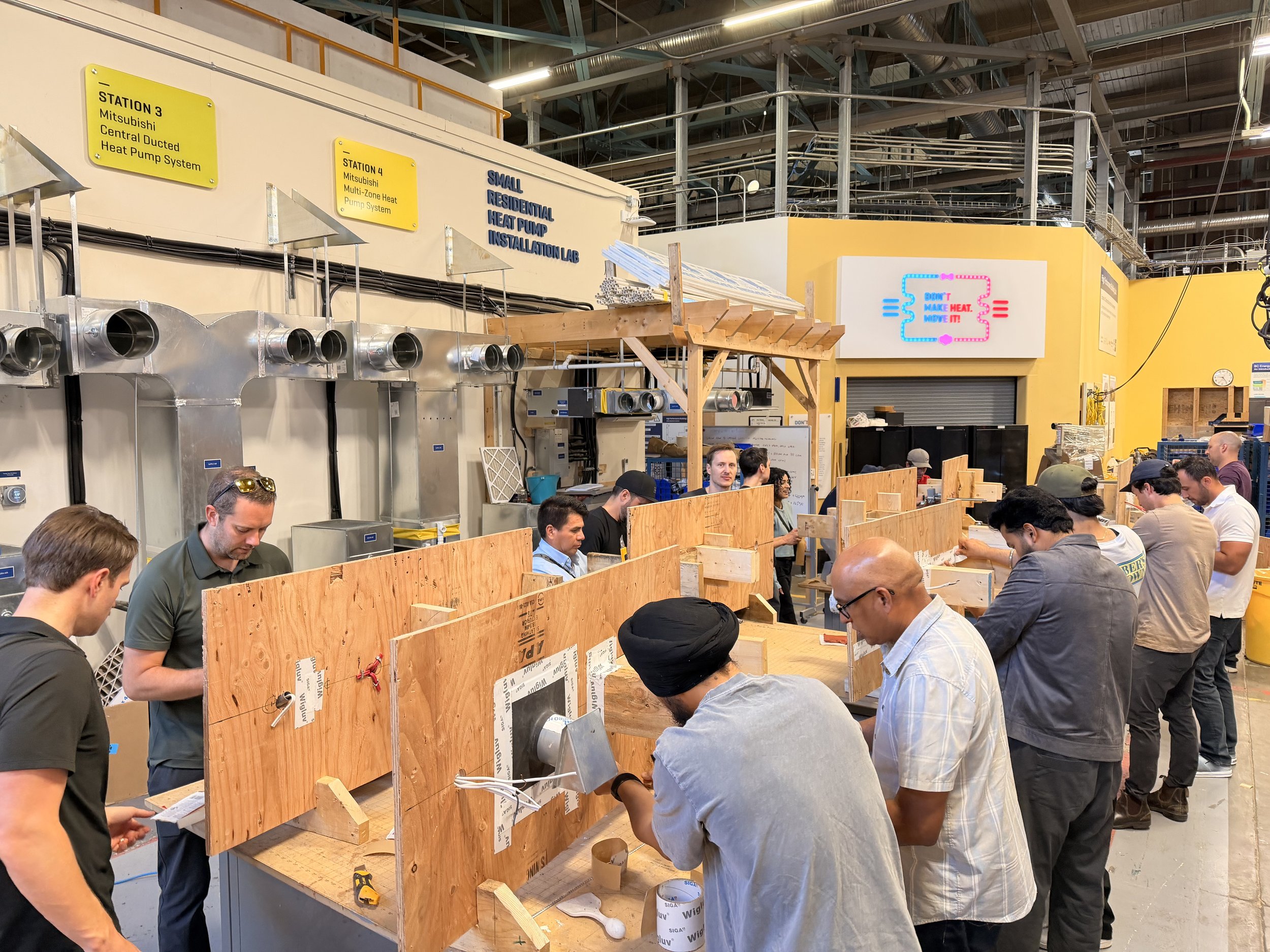
Ventana Team Sealing up Penetrations. Photo Credit: Cody Brentzen
Creating New Habits
One of the things we’ve learned through the work at BCIT and on projects is that high-performance construction isn’t fundamentally more difficult than conventional construction.
It’s different.
Most assemblies are straightforward once you’ve built them a few times. The challenge isn’t understanding a detail on paper—it’s changing habits that may have been reinforced over decades.
We’re asking people to pause before making a penetration. To think one trade ahead. To ask whether someone else still needs access to that location. To recognize that a small hole today may become a difficult leak to find months later.
Those aren’t difficult skills, but they do require focus, presence, and practice.
Like any habit, they take repetition before they become automatic.
Learning Where Mistakes Are Cheap
That’s one of the reasons I enjoy hands-on training so much.
The laboratory gives people permission to make mistakes.
In fact, I hope they do.
One of my clearest memories is from the first airtight window installation training I attended years ago. Our instructor carefully explained the installation sequence and highlighted all the things that commonly went wrong. Our team listened attentively, then walked over to the mock-up and proceeded to do almost everything we had just been told not to do.
We ended up taking the installation apart and doing it again.
At the time it felt embarrassing. Looking back, it was probably the most valuable part of the day.
Making those mistakes created a kind of muscle memory that has stayed with me ever since. Today, when I’m reviewing details on site or talking through an installation with a contractor, those lessons are still there.
I’m much happier that those mistakes happened in a training lab than on a live construction site, where the consequences would have involved schedule delays, change orders, and frustrated project teams.
The best place to fail is where failure is inexpensive.
Where the only thing bruised is your pride.
Building Relationships Alongside Skills
The technical learning is only part of what happens during these sessions.
During the Ventana workshop, one of the most valuable exercises was a collaborative detail review. Small groups worked through specific project details, including parapet conditions, accessible door sill and jamb conditions, and fixed solar shade connections. They reviewed sequencing, responsibilities, and potential challenges, then shared their observations back with the larger group.
Some questions were resolved in the room. Some were identified as important items to test through a larger mockup. Others clearly needed further review. But the value wasn’t only in the answers. It was in the conversation.
Architects began hearing directly from trades about what is easy to build and what isn’t. Some aspects of construction that the design team had struggled to find a clear answer to for years, was answered in 30 seconds. Consultants gained a better understanding of site constraints. Trades saw how their work affected the continuity of the air barrier. The GC demonstrated that quality isn’t just something written into the specifications—it’s something they expect, support, and are willing to invest in.
People also got to know each other.
That might sound like a small thing, but it changes the dynamic of a project. When you’ve spent a day solving problems together, it’s much easier to pick up the phone a few months later and ask a question before making an assumption.
That willingness to reach out often prevents problems long before they become expensive.
We’ve Seen the Results
Over the years, we’ve had the opportunity to work with some exceptional builders who have embraced this collaborative approach.
Before building Angle of Repose, Tom Stead of TS Construction completed BCIT’s High Performance Building Microcredential. On their first Passive House project, they achieved an extraordinary airtightness result of 0.21 ACH@50Pa.
More recently, VanMar Constructors participated in project-specific training before beginning construction of the Hawthorn Passive House. Their final airtightness test came in at 0.4 ACH@50Pa.
I’ll write more about that project in a future article.
Neither of these results happened because of a single product or one particularly clever detail. They were the outcome of teams that invested time up front, worked through sequencing together, and approached construction with a shared commitment to quality.
Perhaps the most encouraging part is watching what happens after people complete this kind of training.
The common response isn’t, “Wow, that’s complicated.”
It’s usually something much simpler:
“That’s actually not so hard.”
And they’re right.
High-performance construction isn’t rocket science. It’s about creating new habits, paying attention to the details that matter, and developing the confidence that comes from practicing them before you’re under the pressure of a construction schedule.
Commitment Shows Up Early
That’s what stood out to me about the Ventana workshop.
The team showed up ready to participate. People were open, engaged, and willing to ask good questions. The trades, design team, consultants, and GC were all in the same room working toward the same goal: delivering a high-performance, airtight building for the client.
That kind of commitment matters.
It sends a clear message that quality is not being left to chance. It shows the trades that the GC is serious about excellence. It gives the design team a better understanding of how their details will be built. And it gives the whole project team a chance to develop shared expectations before the work is underway.
I left the day encouraged by the conversations, impressed by the team Ventana has assembled, and excited to see the project progress.
Continuing the Conversation
Teaching at BCIT has been one of the most rewarding parts of my career. It keeps me connected to students, to industry, and to colleagues who are constantly asking how we can build better buildings. At the same time, the work we do through JMV Consulting allows me to bring lessons from active projects back into the classroom, creating a conversation between education and practice that benefits both.
If you’re interested in developing your own understanding of high-performance construction, I’d encourage you to explore the opportunities available through BCIT’s Zero Energy Buildings Learning Centre.
The Fundamentals of Zero Energy Emissions and Passive House Buildings (XZEB 1001) course is a practical introduction to the principles behind high-performance construction and Passive House design:
https://www.bcit.ca/courses/fundamentals-of-zero-energy-emissions-and-passive-house-buildings-xzeb-1001/
The BCIT Zero Energy Buildings Learning Centre also continues to support industry through applied research, hands-on training, demonstration projects, and a growing library of free technical resources:
https://www.bcit.ca/zero-energy-building/
Whether you’re a designer, contractor, tradesperson, or owner, my experience has convinced me that investing in people is still one of the best investments a project can make.
Better buildings begin with better teams, and better teams are built long before the first shovel goes into the ground.